



- Negara: United States of America
- Keterangan Kelayakan: Doctor of Medicine MD
- Tarikh Diwartakan: 1971-01-14
There is no translation available.
- Negara: United States of America
- Keterangan Kelayakan: Doctor of Medicine MD
- Tarikh Diwartakan: 1971-01-14
There is no translation available.
- Negara: United States of America
- Keterangan Kelayakan: Doctor of Medicine MD
- Tarikh Diwartakan: 1971-01-14
There is no translation available.
There is no translation available.
- Jadual Peperiksaan Subjek Jabatan
- Permohonan Secara Online
- Panduan Peperiksaan Subjek Jabatan
- Semakan Slip Arahan dan Keputusan Calon Peperiksaan Perkhidmatan Subjek Jabatan (TERKINI)
- Semakan Slip Arahan dan Keputusan Calon Peperiksaan Perkhidmatan Subjek Jabatan (2016 dan selepasnya)
- Semakan Slip Arahan dan Keputusan Calon Peperiksaan Perkhidmatan Subjek Jabatan (2013 dan sebelumnya)
Arkib: Semakan Keputusan PTK, Slip Arahan Calon PTK dan CPD KKM (2008 hingga 2010 sahaja)
Sebarang pertanyaan, sila hubungi :-
Bahagian Pembangunan Kompetensi
Kementerian Kesihatan Malaysia
Blok A Jalan Cenderasari
50590 Kuala Lumpur
Tel : 03-22628400 (General Line)
03-22628402 (Keputusan PTK)
03-22628446 / 03-22628449 ( Slip Arahan Calon dan Keputusan Peperiksaan Subjek Jabatan)
Faks : 03-26971002 (General Line)
03-22628464 (Keputusan PTK)
03-22628460 (Slip Arahan Calon dan Keputusan Peperiksaan Subjek Jabatan)
There is no translation available.
URUSAN KENAIKAN PANGKAT SECARA LALUAN KERJAYA
(PEGAWAI PERUBATAN, PEGAWAI PERGIGIAN DAN PEGAWAI FARMASI)
URUSAN PEMANGKUAN DAN KENAIKAN PANGKAT PEGAWAI KUMPULAN PENGURUSAN DAN PROFESIONAL
(KETUA PERKHIDMATAN ADALAH KETUA PENGARAH KESIHATAN KKM)
- Borang NP(P) 8.2 Pindaan 2018 - Permohonan Pemangkuan
- Borang NP(P) 8.3 Pindaan 2018 - Pengesahan Kenaikan Pangkat
URUSAN PEMANGKUAN DAN KENAIKAN PANGKAT KUMPULAN PELAKSANA
(KETUA PERKHIDMATAN ADALAH KETUA SETIAUSAHA KKM/KETUA PENGARAH KESIHATAN KKM)
- Borang PP-1 - Surat Akuan Pinjaman Pendidikan Institusi Atau Tabung Pendidikan
- BORANG PEMANGKUAN NPS(M) 1/2015 Pindaan 2023
- Borang Permohonan Perakuan TBK 13 Tahun (diisi oleh calon)
- Borang NP(S) 8.2 Pindaan 2023 Pengesahan Kenaikan Pangkat
- Borang NP(S) 8.4 Pindaan 2021 Perakuan Kenaikan Pangkat TBK1 dan TBK2 (diisi oleh pentadbir)
- Lampiran C - Notis Penolakan TBK 13 Tahun
- Tarikh Iklan : 02-10-2025
- Tarikh Tutup Permohonan: 07-11-2025
There is no translation available.
- Tarikh Iklan : 01-10-2025
- Tarikh Tutup Permohonan: 07-11-2025
There is no translation available.
There is no translation available.
There is no translation available.
HEALTH ADVISORY FOR WORKPLACES DURING HAZE
MINISTRY OF HEALTH, MALAYSIA
Introduction
Haze is a situation where there is pollution to the air by suspended particulate matter. The various determinants of air pollution are, Sulphur Dioxide, Nitrogen Dioxide, Ozone, Carbon Monoxide and PM10. The fine particulate matter or PM10 (particulate of size 10 micron and below) is the main concern as it may lead to adverse health conditions.
Haze is caused when sunlight encounters tiny pollution particles in the air. Some light is absorbed by particles while other light is scattered away before it reaches an observer. The more the pollutants, the more the absorption and scattering of light, which reduces the clarity and color of what we see. Air quality is determined by the Air Pollutant Index which is measured by the Department of Environment, Ministry of Natural Resources and Environment.
The Occupational Safety and Health Act 1994, stipulates that it is the responsibility of the employer to ensure the safety, health and welfare of the employee. The employer is thus responsible to ensure that preventive measures are taken for employees who are performing their tasks during the haze.
Health Effects of Haze
Exposure to haze may cause a variety of adverse health effects. The small particles that cause haze are composed of microscopic solids or liquid droplets that are so small that they can get deep into the lungs and cause serious health problems. When inhaled, they can enter the bloodstream and get absorbed by underlying tissue, potentially interacting with other compounds and substances in the body, for example ‘bad’ cholesterol, to produce damaging effects such as inflammation.
Short-term adverse effects of exposure to haze:
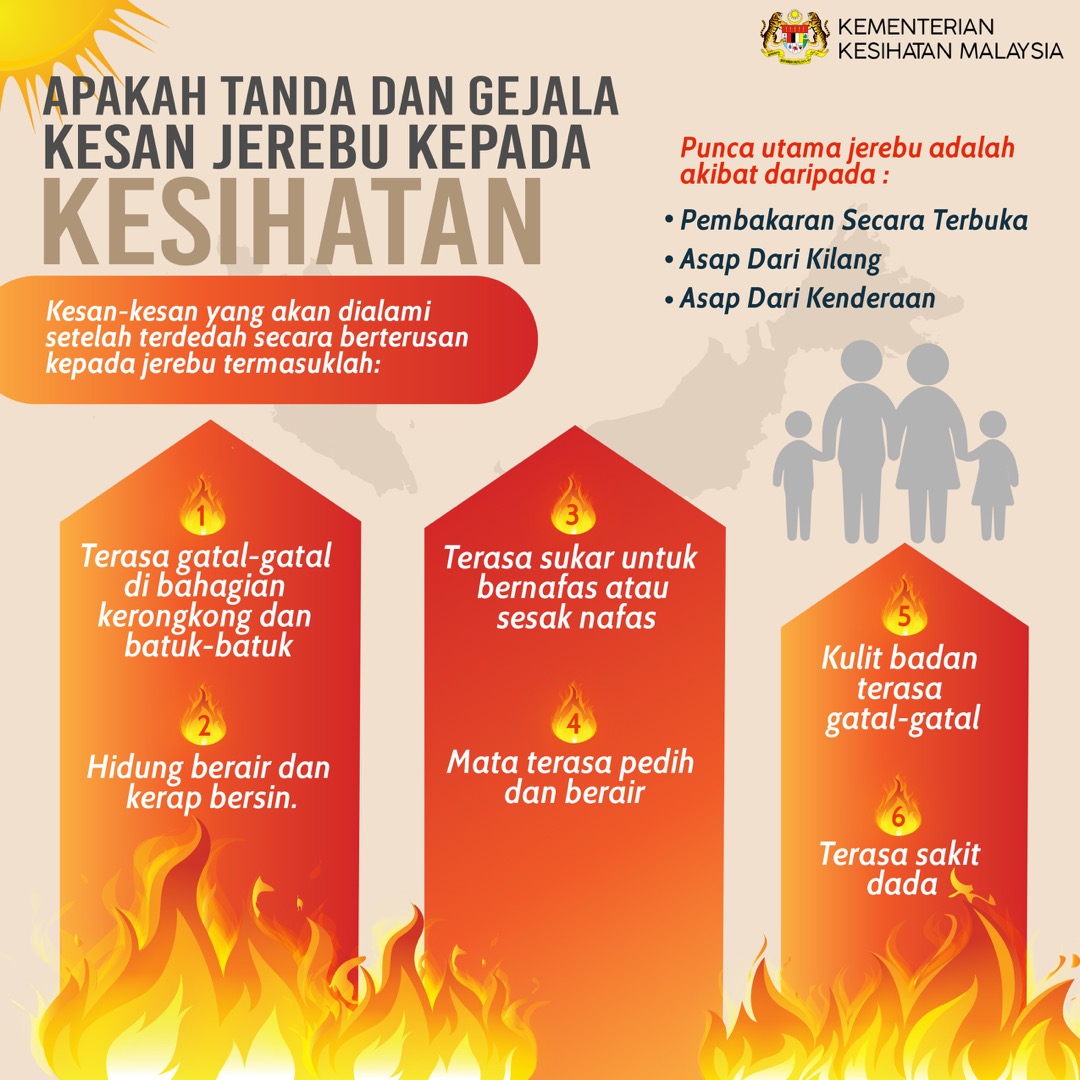
- Eye irritation, watering eyes, and/or conjunctivitis (a type of eye inflammation)
- Running nose, stuffy nose, sneezing, and/or post-nasal drip
- Throat irritation, dry throat, sore throat and/or coughing, phlegm
- Headache, dizziness, fatigue and/or stress
- Decreased lung function, depressed respiratory immune defenses, chest tightness, chest pain, shortness of breath, bronchitis (lung inflammation)
These symptoms are usually mild and will subside if exposure to haze is limited by staying indoors. However, in susceptible individuals (e.g. diabetics, elderly) and those suffering from chronic disease, especially respiratory and heart disease (e.g. coronary artery disease, asthma and chronic obstructive pulmonary disease), their condition may be worsened by haze and are more likely to experience more severe haze-related effects than healthy people.
Long-term effects of exposure to haze
A large number of particles in a haze are below 2.5 micrometers in diameter. Therefore these ultra small particles stay in the air longer and are easily carried over long distances, increasing their chances of being inhaled by animals and humans.
The long-term risks associated with exposure to fine particles:
- Faster rate of thickening of the arteries compared to others, promoting the development of vascular diseases.
- Increases the risk of death by cardiovascular disease and reduces life expectancy by several months to a few years
- May contribute to the development of diabetes
- Spontaneous abortion, under-weight infants, birth defects and infant death.
General Measures at the Workplace
- Minimize outdoor activities.
Identify outdoor work that may be reduced. Ensure the use of respirator for those with prolonged exposure. Those suffering from chronic illnesses, especially heart and respiratory diseases, should remain indoors.
- Close all windows, doors and any openings that may allow haze to enter the workplace.
Turn on the air conditioner if available. Ensure adequate ventilation in the closed room.
- Ensure maintenance of the air conditioner with regular cleaning and servicing.
Fine particles can enter an air-conditioned building through the fresh air intake and by infiltration through openings and gaps.
- Use an air purifier to keep the particulate levels low.
An air purifier or air cleaning devices may be used to reduce the amount of air contaminants that may be circulating in the building.
- Provide health education regarding Haze to the employees
- Provide respirators for employees who have to work outdoors
Ensure there is sufficient supply of respirators for employees who have to work outdoors
- Conduct Fit Testing
Fit testing should be conducted for employees who need to use respirators
- Reassignment of job tasks
Susceptible employees should be reassigned to indoor tasks until the level of pollution is healthy
General Measures for the Workers
- Inform the management if you are suffering from any heart or respiratory diseases
- Take your medication regularly if suffering from an existing disease, especially heart disease and respiratory diseases.
- Drink more water and increase the intake of fresh fruits and vegetables.
This helps the body to flush out toxins absorbed through the skin and lungs, and improve the immune system.
- Cut down on alcohol and coffee
These promote fluid and nutrient loss from the body.
- Avoid smoking
- Wear a respirator when you go outside
Personal Protection
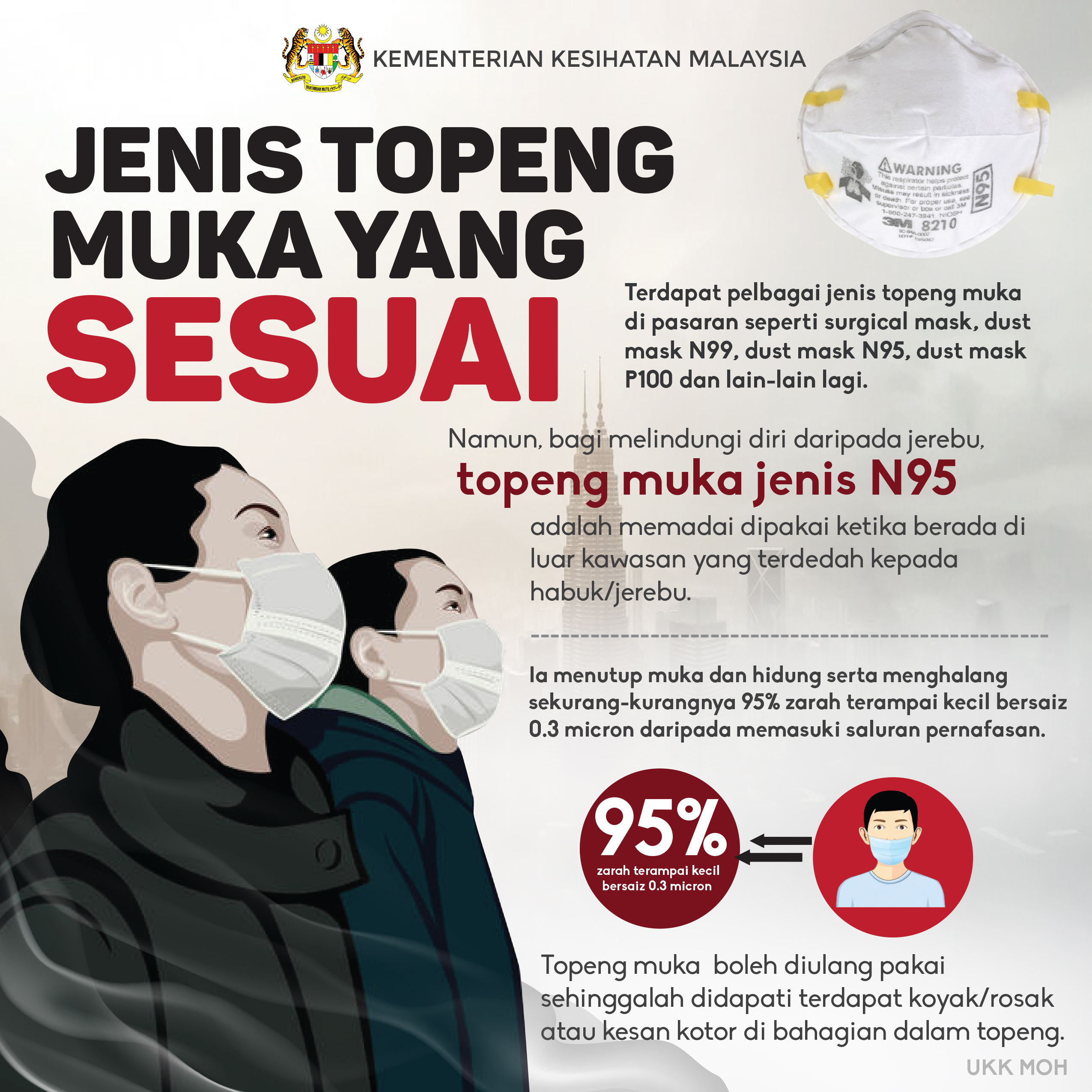
A respirator is a protective device worn covering the nose and mouth and is used to reduce the wearer’s risk of inhaling hazardous airborne particles. The respirator filters small airborne particle which cause haze. The N95 respirator may be used to prevent exposure to the haze. (Refer Usage of Personal Protection During Haze at www.moh.gov.my)
Guidelines on Action to be Taken at The Workplace
|
Air Pollutant Index(API) Reading |
Health Effect Description |
Action to be taken at the workplace |
|
0-50 |
Good |
|
|
51-100 |
Moderate |
|
|
101-200 |
Unhealthy |
|
|
201-300 |
Very Unhealthy |
|
|
301-400 |
Hazardous |
|
|
400-500 |
Hazardous |
|
|
>500 |
Hazardous |
|
There is no translation available.
NASIHAT KESIHATAN KETIKA JEREBU
1. GOLONGAN ORANG YANG BERISIKO TINGGI SEMASA JEREBU
Keadaan jerebu yang berterusan akan mendatangkan kesan buruk kepada semua orang terutama yang berisiko tinggi seperti kanak-kanak, orang tua, wanita mengandung , pesakit jantung dan respiratori juga mereka yang sensitive kepada habuk, orang yang merokok termasuk mereka yang sentiasa bekerja di luar pejabat atau rumah.
2. NASIHAT KESIHATAN SECARA UMUM UNTUK MENCEGAH PENYAKIT AKIBAT JEREBU
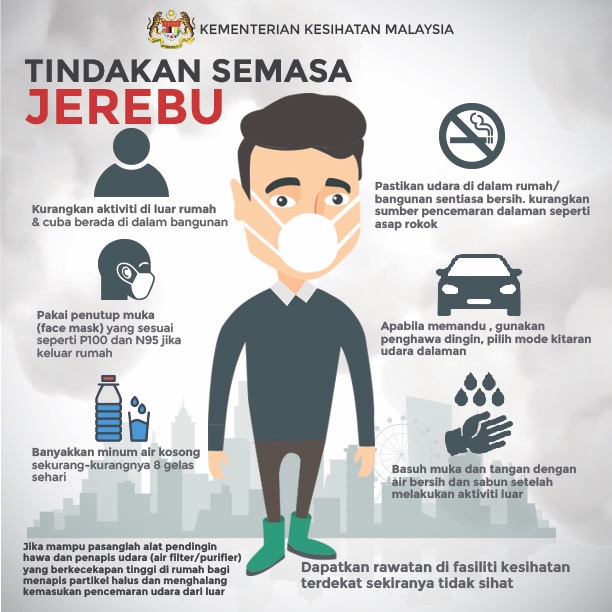
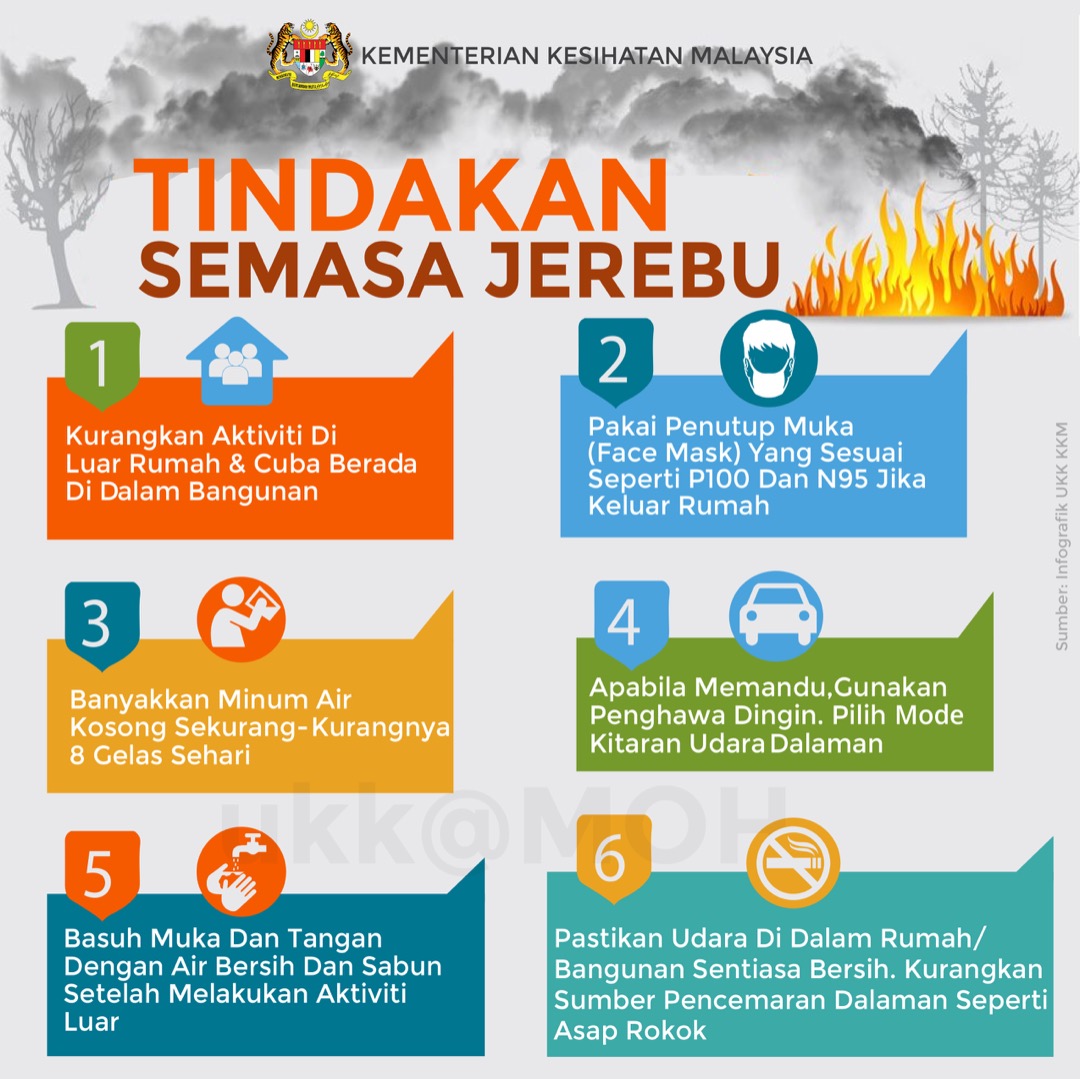
- Orang ramai dinasihatkan supaya sejauh mana yang boleh berada di dalam bangunan.
- Kurangkan aktiviti lasak di luar rumah.
- Orang ramai dinasihatkan supaya kerap membasuh muka dan bahagian-bahagian yang terdedah kepada jerebu.
- Orang ramai dinasihatkan supaya minum banyak air.
- Mereka yang menggunakan kenderaan yang berhawa dingin hendaklah menghidupkan alat penghawa dingin (mod : kitaran dalam) dan menutup semua tingkap.
- Penutup hidung dan mulut hendaklah digunakan oleh mereka yang melakukan aktiviti di luar terutamanya mereka yang berisiko tinggi.
- Mereka yang mengalami penyakit-penyakit seperti batuk, selsema, asma, sakit mata, jangkitan paru-paru yang kronik hendaklah datang ke klinik dengan seberapa segera jikalau keadaan penyakit bertambah teruk.
- Perokok dinasihatkan supaya berhenti merokok.
- Sentiasa mendapatkan maklumat terkini daripada media massa dan mengikut nasihat daripada pihak berkuasa.
3. LANGKAH-LANGKAH PENCEGAHAN DAN KAWALAN KESIHATAN YANG PERLU DIPATUHI SEMASA JEREBU
|
Bacaan Indeks Pencemaran Udara (IPU) |
Status | Tahap Pencemaran | Langkah-langkah pencegahan dan kawalan Kesihatan |
|
0-50 |
Baik |
Tahap pencemaran rendah dan tidak membahayakan kesihatan umum |
|
|
51-100 |
Sederhana |
Tahap pencemaran sederhana dan lazimnya tidak membahayakan kesihatan umum |
|
|
101-200 |
Tidak sihat |
Tahap pencemaran boleh menjejaskan kesihatan golongan berisiko tinggi. |
|
|
201-300 |
Sangat tidak menyihatkan |
Tahap pencemaran tinggi yang menjejaskan kesihatan orang ramai dan boleh memburukkan gejala yang dialami oleh mereka yang berisiko tinggi |
|
|
301-400 |
Berbahaya |
Pencemaran yang sangat tinggi dan membahayakan kesihatan. |
|
|
401-500 |
Berbahaya |
Pencemaran yang sangat tinggi dan membahayakan kesihatan. |
|
|
500 ke atas |
Darurat |
Pencemaran yang terlalu tinggi dan sangat membahayakan kesihatan. |
|
Lampiran-lampiran:
langkah pencegahan semasa jerebu 2013.pdf (188.5 KB / 570 Muat turun)